
Commercial real estate portfolios are under growing pressure to protect building systems, tenant data, and operational technology from increasingly sophisticated cyber threats. The challenge for MF & CRE technology and security leaders is finding a cybersecurity partner who understands the unique demands of property operations, from building management systems to multi-site IT environments. 5Q specializes in Multifamily & CRE cybersecurity, helping portfolio owners and operators assess, protect, and monitor their environments with full-service SOCaaS and OT/IoT security designed for connected buildings.
This guide walks you through how to evaluate cybersecurity services for your commercial real estate portfolio. You will learn what questions to ask, which capabilities matter most, and how to identify providers who genuinely understand CRE operations versus those who offer generic IT security repackaged for the industry.
Key Takeaways: How to Evaluate CRE & Multifamily Cybersecurity Services in 2026
- Property cybersecurity requires deep understanding of building systems, OT networks, and property-level operations, not just corporate IT protection.
- SOCaaS delivers 24/7 monitoring and threat response without requiring a full in-house security team, making it ideal for portfolio-scale coverage.
- OT and IoT protection is critical because building automation systems often run on flat networks with outdated firmware and default credentials.
- 5Q combines CRE & Multifamily-specific expertise with full-service cybersecurity offerings, including penetration testing and building cyber assessments across portfolios.
- Evaluate providers based on their experience with CRE or Multifamily workflows, integrator relationships, and ability to segment OT from corporate IT networks.
Why MF & CRE Cybersecurity Requires a Different Approach
Most cybersecurity providers build their offerings around corporate IT environments: endpoints, cloud applications, and email security. Commercial and Multifamily Real Estate has those needs, but also a much larger attack surface that includes building automation systems, access control, HVAC controls, parking systems, and elevator networks among others.
These operational technology systems are often managed by third-party integrators, run on protocols that predate modern security standards, and share network segments with tenant systems or guest Wi-Fi. A provider without CRE experience may not even know to ask about these exposures during an initial assessment.
The right cybersecurity partner understands that your portfolio is not a single network; it is a federation of systems across multiple buildings, vendors, and ownership structures. Security must be designed around that reality.
The OT Security Gap in Commercial Real Estate
Building management systems (BMS), building automation systems (BAS), and connected devices like smart meters and occupancy sensors are often the weakest links in a CRE security posture. Many of these systems were installed years ago with default credentials that were never changed.
A recent analysis of OT security in CRE portfolios found that firmware between eight and twelve years old is routine on building controllers. Patching often requires vendor site visits, change windows, and tenant notifications, so it rarely happens on any meaningful schedule.
When you evaluate a cybersecurity provider, ask specifically how they handle OT environments. If they only talk about endpoint protection and email filtering, they are not equipped to secure your buildings.
What to Look for in a CRE or Multifamily Cybersecurity Provider
Choosing a cybersecurity partner is not about finding the provider with the longest feature list. It is about finding the team who understands your operational realities and can build a security program around them.
Deep Industry Experience
Ask how many commercial real estate clients the provider currently serves. Ask about the types of properties they protect: office, multifamily, industrial, retail, etc. A provider who specializes in Multifamily and/or CRE will understand the differences between tenant network requirements in a Class-A office tower versus a mixed-use development.
5Q has spent over ten years focused exclusively on technology and cybersecurity for commercial real estate. That focus means every engagement starts with an understanding of property operations, not a generic IT security playbook.
Full-Stack Security Coverage
Effective Multifamily and CRE cybersecurity covers multiple layers: corporate IT, property-level OT, IoT devices, and the connections between them. Look for providers who can assess and protect all of these, not just the pieces that fit neatly into a standard managed security offering.
Key capabilities to evaluate include:
- Security Operations Center as a Service (SOCaaS) with 24/7 monitoring
- Extended detection and response (XDR) across IT and OT environments
- Penetration testing tailored to CRE operations
- Building cyber assessments that identify vulnerabilities in BMS and BAS systems
- Security architecture design and implementation
Integrator and Vendor Relationship Management
Third-party integrators are often the real attack surface in commercial real estate. The company that installed your Niagara or Metasys system has remote access to your building. Their credentials are effectively your credentials.
Your cybersecurity provider should be able to inventory all integrator and vendor access paths, assess the security posture of those relationships, and help you establish access controls that limit exposure without breaking operational workflows.
Understanding SOCaaS for Commercial Real Estate Portfolios
Security Operations Center as a Service (SOCaaS) gives you 24/7 threat monitoring and response without the cost of building an in-house security operations team. For CRE and Multifamily organizations managing multiple properties, SOCaaS is often the most practical path to portfolio-wide coverage.
How SOCaaS Works
A SOCaaS provider monitors your networks (both corporate IT and property OT) for signs of malicious activity. When a threat is detected, the SOC team investigates, contains the threat if necessary, and alerts your internal team with clear guidance on next steps.
The key advantage is continuous coverage. Cyber attacks do not happen on a schedule. Ransomware detonates on Friday afternoons. Credential theft happens overnight. Without 24/7 monitoring, threats can sit undetected for days or weeks.
What to Evaluate in a SOCaaS Provider
Not all SOCaaS offerings are built the same. When evaluating providers for portfolios, ask these questions:
- Does the SOC monitor OT protocols like BACnet/IP and Modbus TCP, or only standard IT traffic?
- Can the SOC see inside building automation networks, or only corporate endpoints?
- What is the average response time when a threat is detected?
- How does the SOC integrate with your existing IT and facilities teams?
5Q's Centry Managed Security solution offers XDR-based SOCaaS specifically designed for commercial real estate. It connects cyber experts directly to your corporate and property networks for "inside the walls" monitoring that generic SOC providers cannot match.
Evaluating OT and IoT Security Capabilities
Operational technology and IoT devices present unique security challenges that require specialized expertise. A provider who treats OT security as an afterthought will leave your buildings exposed.
The Unique Risks of Building Systems
Building automation systems control HVAC, lighting, access control, elevators, and fire safety. When these systems are compromised, the consequences go beyond data theft; they affect the physical safety and comfort of everyone in the building. Unlike corporate IT, where patches can be deployed centrally, OT devices often require manual firmware updates that involve taking systems offline. Many devices have reached end-of-life status with their manufacturers, meaning no patches are available at all.
Attackers increasingly target these systems precisely because they know defenses are weak. AI-powered vulnerability discovery tools are lowering the skill barrier for finding and exploiting OT weaknesses, making these systems attractive targets for a growing pool of threat actors.
Key OT Security Capabilities to Require
When evaluating cybersecurity providers for OT protection, look for these specific capabilities:
- Asset inventory: A current, authoritative inventory of every controller, sensor, and gateway across your portfolio, including firmware versions.
- Network segmentation: Verified separation between OT networks and corporate IT, with evidence that the BAS cannot reach your domain controller.
- Protocol-aware monitoring: Detection capabilities that understand BACnet, Modbus, KNX, and other building protocols.
- Patch and EOL tracking: Visibility into which devices are unpatched and which have reached vendor end-of-life.
IoT Device Security Across Your Portfolio
Smart building IoT devices (occupancy sensors, smart meters, connected thermostats) create visibility into building operations but also expand your attack surface. Each device is a potential entry point if not properly secured.
5Q's approach to IoT security integrates protection from the start, ensuring every device and user is authenticated and verified before accessing network resources. Regular vulnerability scanning identifies at-risk devices, and real-time threat detection monitors for anomalies across all connected systems.
Questions to Ask During Provider Evaluation
The right questions will quickly reveal whether a cybersecurity provider understands CRE/Multifamily operations or is simply applying generic security practices to your portfolio.
About CRE/Multifamily Experience
- How many commercial real estate clients do you currently serve?
- What property types?
- Can you describe a recent engagement where you identified and resolved a security gap specific to building operations?
Providers who specialize in CRE will have concrete examples. Providers who do not will give vague answers about "adapting" their approach to different industries.
About OT and Building Systems
- How do you conduct assessments of building automation systems?
- What protocols can your SOC monitor?
- How do you handle integrator access management?
If the provider does not have clear answers about BACnet, Modbus, or Niagara/Metasys environments, they lack the expertise you need.
About Portfolio-Scale Operations
- How do you handle security across a portfolio with multiple buildings, different integrators, and varied system ages?
- Can you show me how you have helped other CRE clients achieve consistent security posture across diverse assets?
CRE portfolios are not monolithic. Acquisitions bring in unknown OT, unknown vendors, and unknown remote access paths. Your provider needs to have a methodology for handling that complexity.
About Ongoing Support and Response
- What happens when a threat is detected at 2 AM on a Saturday?
- Who is responsible for containment?
- How quickly can you respond to an incident affecting building operations?
Response time matters. A ransomware actor inside your BAS for eleven days is a very different outcome than one contained in eleven minutes.
How to Assess Vendor Credentials and Track Record
Claims are easy. Evidence is harder. A rigorous evaluation process includes verification of the provider's credentials and references from similar organizations.
Industry-Specific References
Ask for references from CRE clients with portfolios similar to yours in size and property type. Speak with those references about specific outcomes:
- Did the provider identify risks that previous assessments missed?
- How responsive is their SOC?
- How well do they coordinate with property management and facilities teams?
A large office-owning 5Q client reported that their building cyber assessments "confirmed our worst fears" about unaddressed building system vulnerabilities and led to action plans that they extended across their entire portfolio.
Certifications and Frameworks
Look for alignment with established security frameworks like NIST Cybersecurity Framework and CIS Controls. These frameworks provide structure for assessing risk, implementing controls, and measuring progress over time.
Ask how the provider uses these frameworks in practice. A provider who simply lists certifications without explaining how they apply to your environment is not adding value.
Proof of OT Expertise
Request examples of OT-specific work: building cyber assessments, BAS penetration tests, segmentation projects. Ask for sanitized deliverables that show the depth of their analysis and the practicality of their recommendations.
Building an Evaluation Scorecard
Comparing providers is easier when you have a structured framework. Create a scorecard that weights the criteria most important to your organization.
Suggested Evaluation Criteria
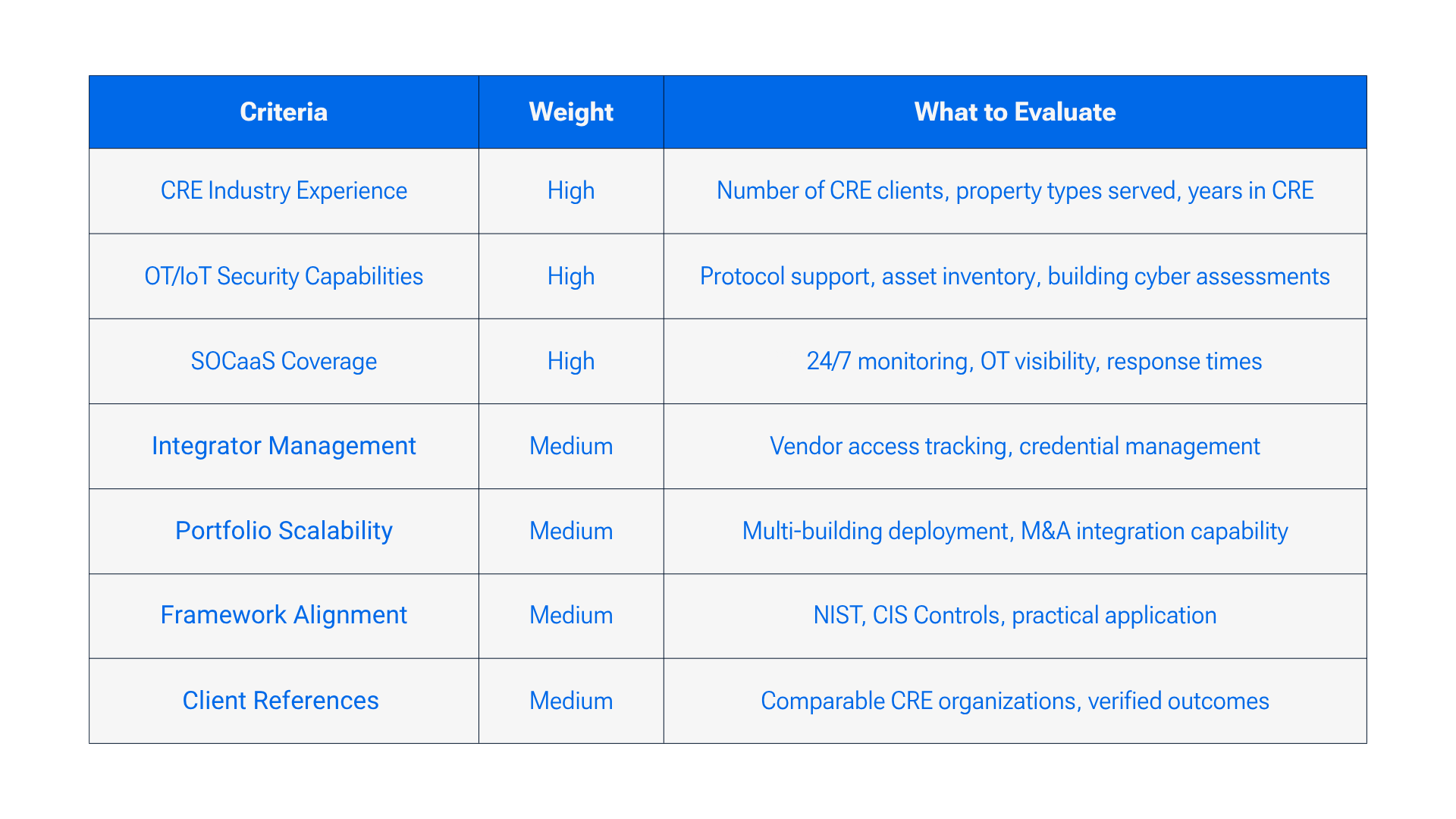
Conducting the Evaluation
Score each provider against your criteria based on documentation, demonstrations, and reference calls. Weight the scores according to your organization's priorities. A provider with excellent corporate IT security but no OT capability may score well on some dimensions but fail on the factors that matter most for CRE.
Common Mistakes When Selecting CRE Cybersecurity Services
Avoid these pitfalls during your evaluation process.
Choosing Based on Price Alone
Cybersecurity is not an area where the lowest bid wins. A provider who underprices will likely cut corners on coverage, expertise, or response capabilities. The cost of a single significant incident will far exceed any savings from choosing a cheaper provider.
Ignoring OT in the Evaluation
If your evaluation focuses only on corporate IT security, you will end up with a provider who cannot protect your buildings. Make OT and IoT security a gating criterion, not an afterthought.
Accepting Generic Security Playbooks
Watch out for providers who present cookie-cutter approaches without adapting to CRE realities. If their proposal could apply equally to a healthcare system or a retail chain, they have not done the work to understand your environment.
Overlooking Integrator Relationships
Your integrators are part of your security perimeter. A provider who does not ask about integrator access during discovery is missing a critical attack vector.
The Timeline for Improving Your CRE Security Posture
Building real security takes time. Set realistic expectations for what you can accomplish in different timeframes.
First 90 Days
Focus on visibility. Complete an asset inventory across your portfolio. Identify all integrator and vendor access paths. Assess network segmentation between OT and IT. Establish baseline monitoring.
Six to Twelve Months
Address critical gaps. Implement segmentation where it does not exist. Deploy SOCaaS coverage across corporate and property networks. Begin building cyber assessments of high-risk properties. Establish vendor access controls.
Twelve to Twenty-Four Months
Build maturity. Extend assessments and protections across the full portfolio. Develop patch and EOL management processes for OT devices. Integrate security into acquisition due diligence. Conduct red team exercises to test defenses.
Making the Final Decision
After completing your evaluation, you should have clear differentiation between providers who understand CRE and those who do not. The decision comes down to which provider can best address your specific portfolio's needs while growing with you over time.
Trust your evaluation criteria. If a provider scores well on CRE experience, OT capabilities, and client references, those factors should outweigh minor differences in other areas.
If you are seeing recurring technology issues, unclear ownership of security responsibilities, or vendor-related concerns across your portfolio, 5Q can help. 5Q's cybersecurity team brings deep industry expertise, full-service SOCaaS, and specialized OT/IoT protection designed for multifamily and commercial real estate operations.
In Conclusion: Selecting the Right Cybersecurity Partner for Your CRE Portfolio
Evaluating cybersecurity services for commercial real estate requires looking beyond standard IT security criteria. Your portfolio faces unique risks from building automation systems, third-party integrators, and IoT devices that generic providers are not equipped to address.
Focus your evaluation on CRE-specific experience, OT security capabilities, SOCaaS coverage, and the provider's ability to manage integrator relationships. Use structured criteria to compare providers objectively, and verify claims through references from similar CRE organizations.
The window to build a strong security posture is narrowing as cyber threats become more sophisticated and AI-powered attack tools become more accessible. Starting that work now, with a partner who understands commercial real estate, positions your portfolio for resilience in an increasingly challenging threat environment.
FAQs about How to Evaluate CRE Cybersecurity Services in 2026
What is SOCaaS and why does it matter for commercial real estate?
SOCaaS stands for Security Operations Center as a Service. It delivers 24/7 threat monitoring and response without requiring you to build an in-house security team.
For CRE portfolios with multiple buildings and limited internal security staff, SOCaaS is the most practical path to consistent protection. 5Q's Centry Managed Security offers SOCaaS specifically designed for commercial real estate, with visibility into both corporate IT and property OT networks.
Why is OT security so important for commercial real estate portfolios?
Operational technology controls your building systems—HVAC, access control, elevators, lighting. These systems often run on outdated firmware with default credentials and minimal security.
When OT systems are compromised, attackers can disrupt building operations, demand ransom, and pivot to other properties in your portfolio. 5Q assesses OT environments and implements protections that most generic cybersecurity providers cannot address.
How do I know if a cybersecurity provider understands commercial real estate?
Ask about their CRE client base, the property types they protect, and specific examples of building-level security work. Providers with CRE expertise will discuss building automation systems, integrator relationships, and OT protocols without prompting.
If a provider only talks about endpoints, email security, and cloud applications, they do not have the depth you need.
What questions should I ask about integrator and vendor access?
Ask the provider how they inventory vendor access paths, how they assess integrator security posture, and how they help you implement access controls. Your building integrators have remote access to critical systems—that access is part of your security perimeter.
5Q helps CRE organizations map all integrator relationships and establish controls that protect your buildings without disrupting operational workflows.
How long does it take to improve cybersecurity posture across a CRE portfolio?
Meaningful improvement takes time. Expect to spend the first 90 days on visibility—asset inventory, access mapping, and baseline monitoring. Critical gaps can be addressed over six to twelve months, with full portfolio maturity achieved in twelve to twenty-four months.
Starting now gives you time to build defenses before the threat environment becomes more challenging.
What makes 5Q different from other CRE cybersecurity providers?
5Q focuses exclusively on technology and cybersecurity for commercial real estate. With over ten years of CRE experience, 5Q's team understands building systems, property operations, and the unique challenges of securing multi-site portfolios.
5Q offers full-service SOCaaS through Centry Managed Security, plus building cyber assessments, penetration testing, and security architecture designed specifically for CRE environments.


.webp)


.svg)

